7.3 - Type I Recovery Requirements
Module: Type I Small Appliances
Regulatory verification date: August 11, 2026
Primary authority: Current 40 CFR §§ 82.156 and 82.158 and current EPA Section 608 service-practice, recovery-equipment-certification, and Type I test-topic guidance
Course role: Establishes the recovery endpoint that must be achieved before opening or disposing of a qualifying small appliance and explains how the required endpoint depends on the recovery equipment manufacture date and, for newer equipment, whether the appliance compressor is functioning
Learning Objectives
After completing this section, a student should be able to:
- State when refrigerant recovery is required before opening or disposing of a small appliance.
- Explain why the November 15, 1993 date refers to the recovery or recycling equipment, not the refrigeration appliance.
- State the 80 percent requirement when recovery equipment was manufactured before November 15, 1993.
- State the 90 percent requirement when recovery equipment was manufactured on or after November 15, 1993 and the appliance compressor is functioning.
- State the 80 percent requirement when recovery equipment was manufactured on or after November 15, 1993 and the appliance compressor is not functioning.
- Explain the alternative 4 in. Hg vacuum recovery endpoint.
- Distinguish a percentage-of-charge recovery requirement from an inches-of-mercury vacuum endpoint.
- Explain why the small-appliance recovery rule is separate from the main evacuation table used for other appliances.
- Explain why recovery and recycling equipment must be appropriate and certified for the intended use.
- Explain the difference between recovery-equipment certification performance and the technician’s field recovery requirement.
- Explain why recovery equipment must be used according to the manufacturer’s directions unless those directions conflict with federal requirements.
- Apply the Type I recovery decision process to exam-style scenarios.
Introduction
Once equipment has been correctly classified as a small appliance, the next question is:
How much refrigerant must be recovered before the appliance is opened or disposed of?
Current 40 CFR §82.156(b) gives a separate rule specifically for small appliances.
The required recovery result depends primarily on:
Recovery-equipment manufacture date
+
Appliance compressor condition
with an alternative:
4 in. Hg vacuum
The current rule can be summarized as:
| Recovery Condition | Required Result |
|---|---|
| Recovery equipment manufactured before November 15, 1993 | Recover 80% |
| Recovery equipment manufactured on or after November 15, 1993 + appliance compressor functioning | Recover 90% |
| Recovery equipment manufactured on or after November 15, 1993 + appliance compressor not functioning | Recover 80% |
| Alternative allowed by the rule | Evacuate appliance to 4 in. Hg vacuum |
This table is one of the highest-priority Type I facts to know.
The most important warning is:
The November 15, 1993 date applies to the recovery or recycling equipment—not to the small appliance being serviced.
A refrigerator manufactured in 1985 does not automatically use the “pre-1993” recovery requirement.
A refrigerator manufactured in 2026 does not automatically use the “post-1993” requirement.
The question is:
When was the recovery equipment manufactured?
Key Concepts
1. Recovery Is Required Before Opening or Disposal
Current 40 CFR §82.156(b) states that before:
- Opening a small appliance, or
- Disposing of a small appliance,
the person must recover refrigerant using recovery and/or recycling equipment meeting the applicable requirements.
The sequence is:
Identify small appliance
→ determine required recovery endpoint
→ recover refrigerant
→ verify endpoint
→ then open or dispose
The recovery requirement is intended to prevent avoidable refrigerant release.
2. The Small-Appliance Rule Is Separate From the Main Table 1 Rule
The general Table 1 evacuation requirements in §82.156(a) apply to appliances except:
- Small appliances.
- MVACs.
- MVAC-like appliances.
Therefore, a qualifying small appliance does not use the ordinary high-pressure or medium-pressure Table 1 value simply because its refrigerant happens to fall into one of those pressure categories.
For Type I:
Small appliance
→ use §82.156(b)
not:
Small appliance
→ automatically use main Table 1
This is a major exam distinction.
3. The November 15, 1993 Date Refers to Recovery Equipment
The current rule distinguishes:
Recovery equipment manufactured before November 15, 1993
from:
Recovery equipment manufactured on or after November 15, 1993
The date does not refer to:
- Refrigerator manufacture date.
- Window air-conditioner manufacture date.
- Compressor manufacture date.
- Refrigerant manufacture date.
- Date the appliance was installed.
- Date the technician became certified.
The correct question is:
When was the recovery or recycling equipment manufactured?
4. Functional Compressor Matters Only in the Newer-Equipment Percentage Path
When using recovery equipment manufactured on or after November 15, 1993, the required percentage depends on whether the compressor in the appliance is functioning.
Compressor functioning
→ 90%
Compressor not functioning
→ 80%
For equipment manufactured before November 15, 1993, the field percentage requirement is:
80%
regardless of whether the appliance compressor is functioning.
5. The 4 in. Hg Vacuum Alternative Is a Separate Compliance Path
The rule also permits:
Evacuate the appliance to 4 in. Hg vacuum
This gives a technician another way to satisfy the small-appliance recovery requirement.
Therefore, the logic is not:
must always calculate 80% or 90%
The rule allows:
percentage recovery
OR
4 in. Hg vacuum
when the applicable conditions are satisfied.
6. “4 in. Hg Vacuum” Is Not a Deep Dehydration Vacuum
The Type I value:
4 in. Hg vacuum
is a refrigerant-recovery endpoint.
It is not a deep dehydration target measured in:
microns
Do not confuse:
refrigerant recovery
with:
deep evacuation / dehydration
Deep evacuation and dehydration are different procedures serving different purposes.
7. Percentage Recovery and Vacuum Level Are Different Measurement Methods
An 80% or 90% recovery requirement describes the fraction of the refrigerant charge that is removed.
A 4 in. Hg vacuum requirement describes the pressure condition reached inside the appliance.
They are not the same type of measurement.
80% / 90%
→ refrigerant quantity removed
4 in. Hg vacuum
→ appliance pressure endpoint
Do not attempt to convert one directly into the other.
Current Type I Recovery Requirement
Decision Table
| Recovery Equipment Manufacture Date | Appliance Compressor Condition | Required Recovery |
|---|---|---|
| Before Nov. 15, 1993 | Functioning | 80%, or 4 in. Hg vacuum alternative |
| Before Nov. 15, 1993 | Not functioning | 80%, or 4 in. Hg vacuum alternative |
| On or after Nov. 15, 1993 | Functioning | 90%, or 4 in. Hg vacuum alternative |
| On or after Nov. 15, 1993 | Not functioning | 80%, or 4 in. Hg vacuum alternative |
Fast Exam Logic
STEP 1
Is it a qualifying small appliance?
If yes:
STEP 2
When was the recovery equipment manufactured?
If before November 15, 1993:
80% recovery
OR
4 in. Hg vacuum
If on or after November 15, 1993:
STEP 3
Is appliance compressor functioning?
If yes:
90% recovery
OR
4 in. Hg vacuum
If no:
80% recovery
OR
4 in. Hg vacuum
Functional Compressor
1. Meaning in the Recovery Rule
A functional compressor is an appliance compressor that can operate for the recovery procedure.
Its importance is greatest when using:
- System-dependent recovery.
- The post-November 15, 1993 percentage-recovery path.
With newer recovery equipment:
Functional compressor
→ 90% recovery requirement
2. Why a Working Compressor Can Improve Recovery
When the appliance compressor operates, it can help move refrigerant through the refrigeration circuit.
This can help:
- Move refrigerant toward the recovery connection.
- Reduce refrigerant trapped in parts of the system.
- Improve the effectiveness of system-dependent recovery.
The detailed operating-compressor procedure is developed in:
Section 7.5 - Recovery with an Operating Compressor.
3. “Functional” Does Not Mean the Appliance Is Cooling Normally
A compressor can be capable of running even if the appliance has another problem.
For exam purposes, the important question is whether the compressor is available and capable of operation as part of the recovery process.
Do not assume:
appliance does not cool
→ compressor automatically nonfunctional
The actual compressor condition matters.
Nonfunctional Compressor
1. Current Requirement With Newer Recovery Equipment
When recovery equipment was manufactured on or after November 15, 1993 and the appliance compressor is not functioning:
Recover 80%
or use the:
4 in. Hg vacuum alternative
2. Why the Required Percentage Is Lower
A failed compressor can leave refrigerant trapped in:
- Compressor shell.
- Oil.
- Evaporator.
- Condenser.
- Low spots in tubing.
Without compressor operation, recovery can be more difficult, especially with system-dependent methods.
That is why Type I techniques for an inoperative compressor emphasize:
- High-side and low-side access.
- Warming appropriate components.
- Mobilizing trapped refrigerant.
- Correct recovery-equipment setup.
Those methods are developed in:
Section 7.6 - Recovery with a Failed Compressor.
3. Failed Compressor Does Not Mean “No Recovery Required”
A common error is:
Compressor failed
→ refrigerant cannot be recovered
That is incorrect.
The federal recovery requirement still applies.
The technician must use an appropriate method to achieve the applicable endpoint.
Recovery Equipment Manufactured Before November 15, 1993
1. Field Recovery Requirement
For a small appliance using recovery equipment manufactured before November 15, 1993:
Recover 80%
or:
Evacuate to 4 in. Hg vacuum
The 80% field requirement does not change based on appliance-compressor condition.
2. Legacy Equipment Can Still Be Recognized Under the Rule
Current §82.158 provides a legacy pathway for small-appliance recovery equipment manufactured or imported before November 15, 1993.
Such equipment can be considered certified if it is capable of either:
recovering 80%
whether or not the compressor of the test stand is operational,
or:
achieving a 4 in. Hg vacuum
when tested using a properly calibrated pressure gauge.
Therefore:
Pre-1993 equipment is not automatically prohibited solely because it predates the modern third-party certification program.
It must satisfy the applicable legacy standard.
3. Do Not Confuse Old Recovery Equipment With Old Appliances
Example:
1988 refrigerator
+
2020 recovery machine
+
compressor functional
The correct percentage path is based on:
2020 recovery machine
→ on or after Nov. 15, 1993
and:
functional appliance compressor
→ 90%
The refrigerator’s 1988 manufacture date is not the deciding date.
Recovery Equipment Manufactured On or After November 15, 1993
1. Functional Compressor
Recovery equipment on/after Nov. 15, 1993
+
appliance compressor functional
→ 90% recovery
2. Nonfunctional Compressor
Recovery equipment on/after Nov. 15, 1993
+
appliance compressor not functional
→ 80% recovery
3. Certified Equipment
Current EPA guidance states that small-appliance recovery equipment must meet the applicable certification requirements.
EPA-approved testing organizations currently include:
- AHRI.
- UL.
Certified equipment can be identified by the required certification labeling for the appropriate appliance category.
For field work:
equipment labeled/certified for appropriate use
+
compatible with refrigerant and safety requirements
+
used according to manufacturer instructions
is the correct approach.
4. Flammable-Refrigerant Compatibility Matters
Modern small appliances may contain flammable refrigerants.
A recovery machine suitable for a conventional nonflammable refrigerant must not automatically be assumed safe for:
- A2L refrigerant.
- A3 refrigerant.
- Other flammable refrigerant.
Current §82.158 distinguishes equipment standards for newer equipment used with:
non-flammable refrigerants
and:
flammable refrigerants
Therefore:
EPA certification for a category does not eliminate the need to verify refrigerant compatibility and safety rating.
Equipment Certification Versus Field Recovery Requirement
This distinction is important because the same numbers appear in two different contexts.
1. Technician Field Requirement
Current §82.156(b) tells the person recovering refrigerant what result must be achieved before opening or disposing of the small appliance.
Field result:
80%
or
90%
or
4 in. Hg vacuum
depending on the applicable conditions.
2. Recovery-Equipment Certification Performance
Current §82.158(e) establishes how small-appliance recovery equipment is evaluated for certification.
The equipment must demonstrate capability to recover:
90%
→ when test-stand compressor is operational
and:
80%
→ when test-stand compressor is not operational
when tested under the applicable certification method and used according to manufacturer instructions.
The rule also provides alternative certification pathways involving the ability to achieve a:
4 in. Hg vacuum
under applicable test procedures.
3. Why the Distinction Matters
Do not answer:
"What percentage must the technician recover?"
with a statement that only describes laboratory certification testing.
And do not answer:
"What must recovery equipment demonstrate for certification?"
only by quoting a field scenario.
The two concepts are related but not identical.
Manufacturer Instructions
1. Current Federal Rule
Current 40 CFR §82.156(g) requires recovery and/or recycling equipment to be used according to the manufacturer’s directions unless those directions conflict with the requirements of Subpart F.
Therefore:
Manufacturer directions
→ must be followed
unless:
manufacturer direction conflicts with federal requirement
→ federal requirement controls
2. Why Manufacturer Instructions Matter
The manufacturer’s directions can specify:
- Hose configuration.
- Valve sequence.
- Maximum inlet or discharge pressure.
- Required filter/drier use.
- Oil-management procedure.
- Refrigerant compatibility.
- Flammable-refrigerant restrictions.
- Purge procedure.
- Cylinder connection.
- Recovery-completion indication.
- Maintenance requirements.
These details affect both:
- Safety.
- Ability to reach the required recovery result.
3. A Recovery Percentage Is Not a Complete Procedure
Knowing:
90%
does not tell the technician:
- Which access point to use.
- Which hose goes where.
- Whether the compressor should be energized.
- How to avoid liquid slugging.
- How to monitor the recovery cylinder.
- How to prevent cross-contamination.
Those procedures depend on:
- Equipment.
- Appliance.
- Refrigerant.
- Compressor condition.
- Manufacturer instructions.
Later sections develop the Type I procedures.
EPA-Certified Recovery Equipment
1. What “Certified” Means
Recovery and recycling equipment used for Section 608 work must satisfy the applicable federal equipment standards.
Current EPA guidance states that recovery equipment is tested to ensure it meets EPA requirements.
For modern equipment, certification is performed by an EPA-approved testing organization.
2. Current EPA-Approved Testing Organizations
EPA currently identifies:
- Air-Conditioning, Heating, and Refrigeration Institute (AHRI).
- Underwriters Laboratories (UL).
as approved organizations for certification of recovery/recycling equipment.
3. Certification Label
Current §82.158 requires certified equipment in the applicable categories to carry a label indicating that it has been certified by the approved testing organization to meet EPA’s minimum requirements for the appropriate appliance category.
For exam preparation:
Recovery equipment
→ verify appropriate EPA certification / category
Do not assume that any pump capable of moving refrigerant is automatically acceptable recovery equipment.
4. A Vacuum Pump Alone Is Not Automatically a General Recovery Machine
A vacuum pump may appear in certain recovery techniques, particularly system-dependent methods with a suitable nonpressurized recovery container.
But:
vacuum pump
≠
automatic substitute for any certified recovery machine
The complete equipment configuration must satisfy the applicable federal and manufacturer requirements.
This topic is developed in Sections 7.6 and 7.7.
Four-Inch-Hg Vacuum Alternative
1. Current Rule
Current §82.156(b)(3) permits the person to satisfy the small-appliance recovery requirement by:
Evacuating the appliance to 4 in. Hg vacuum
2. Meaning of Vacuum Reading
A vacuum reading means the appliance pressure has been reduced below local atmospheric pressure.
For exam purposes, use the regulatory wording:
4 in. Hg vacuum
Do not rewrite it as:
4 in. Hg absolute
because those are not the same pressure convention.
3. Do Not Convert It to 25 mm Hg Absolute
The value:
25 mm Hg absolute
belongs to the low-pressure appliance evacuation requirement.
It is not the Type I small-appliance alternative.
4. Do Not Convert It to a Micron Dehydration Target
The 4-in.-Hg value is a recovery endpoint.
A deep dehydration vacuum may be far lower in absolute pressure.
The purpose and measurement scale are different.
5. Verify the Endpoint
The recovery procedure is not complete merely because the technician believes “most of the refrigerant is gone.”
The technician must verify that the selected required endpoint has been achieved.
Recovery Requirement Examples
Example 1 — New Recovery Machine, Working Compressor
A household refrigerator is a qualifying small appliance.
The recovery machine was manufactured in 2024.
The refrigerator compressor is functioning.
Recovery equipment:
on/after Nov. 15, 1993

Compressor:
functional

Required percentage:
90%
Alternative:
Evacuate appliance to 4 in. Hg vacuum
Example 2 — New Recovery Machine, Failed Compressor
A window air conditioner is a qualifying small appliance.
The recovery machine was manufactured in 2021.
The appliance compressor is not functioning.
Recovery equipment:
on/after Nov. 15, 1993

Compressor:
not functional

Required percentage:
80%
Alternative:
4 in. Hg vacuum
Example 3 — Legacy Recovery Equipment
A refrigerator is serviced using recovery equipment manufactured in 1992.
The appliance compressor is functioning.
Recovery equipment:
before Nov. 15, 1993

Required percentage:
80%
The working compressor does not raise the field requirement to 90% when the recovery equipment itself is pre-1993.
Example 4 — Old Appliance, Modern Recovery Equipment
A refrigerator was manufactured in 1989.
The recovery machine was manufactured in 2023.
The appliance compressor works.
The incorrect reasoning is:
1989 appliance
→ pre-1993 rule
→ 80%
The correct reasoning is:
2023 recovery equipment
→ post-1993 category
+
compressor functional
→ 90%
Example 5 — Appliance Built in 2025, Pre-1993 Recovery Equipment
A qualifying small appliance was manufactured in 2025.
The recovery equipment was manufactured in 1990.
For the percentage method:
1990 recovery equipment
→ 80%
The appliance’s manufacture date does not control the recovery-equipment date category.
Example 6 — Four-Inch Alternative
A technician uses equipment and procedure capable of properly evacuating a small appliance to:
4 in. Hg vacuum
The technician may satisfy the small-appliance recovery rule using this alternative rather than calculating an 80% or 90% recovered fraction.
A Practical Type I Recovery Decision Procedure
Step 1 — Confirm That It Is a Small Appliance
Use the Section 7.1 definition:
Factory manufactured
+
Factory charged
+
Factory hermetically sealed
+
≤ 5 lb refrigerant
If the equipment is not a small appliance, do not use the Type I small-appliance recovery table.
Step 2 — Identify the Recovery Equipment
Determine:
- Equipment type.
- Manufacturer/model.
- Appropriate appliance category.
- Refrigerant compatibility.
- Manufacture date.
- Certification status.
Step 3 — Determine Which Date Category Applies
Before Nov. 15, 1993?
or:
On/after Nov. 15, 1993?
Step 4 — If Newer Equipment, Determine Compressor Condition
Compressor functional?
If yes:
90%
If no:
80%
Step 5 — Consider the 4 in. Hg Vacuum Alternative
If the procedure and equipment are appropriate:
4 in. Hg vacuum
may be used as the alternative recovery endpoint.
Step 6 — Follow Manufacturer Instructions
Use the recovery equipment according to the manufacturer’s directions unless a direction conflicts with federal requirements.
Step 7 — Verify the Recovery Result
Do not open the appliance merely because recovery has slowed.
Verify that the selected required endpoint has been achieved.
Step 8 — Proceed With Service or Disposal
Only after the recovery requirement is satisfied should the appliance be opened or moved to the next disposal step.
Important Terms
Four Inches of Mercury Vacuum
A pressure endpoint permitted as an alternative small-appliance recovery requirement under current §82.156(b).
It is written:
4 in. Hg vacuum
and should not be confused with:
- 4 in. Hg absolute.
- 25 mm Hg absolute.
- Deep-vacuum micron values.
Functional Compressor
An appliance compressor capable of operating during the recovery procedure.
For recovery equipment manufactured on or after November 15, 1993, a functional compressor corresponds to the 90% percentage-recovery requirement.
Nonfunctional Compressor
An appliance compressor that cannot operate as part of the recovery procedure.
For recovery equipment manufactured on or after November 15, 1993, the applicable percentage-recovery requirement is 80%.
Percentage Recovery
The fraction of the appliance refrigerant charge removed during recovery.
For Type I, the relevant current percentage values are:
80%
and:
90%
depending on recovery-equipment date and compressor condition.
Recovery Equipment Manufacture Date
The date the recovery or recycling equipment was manufactured.
The key regulatory dividing date for Type I recovery is:
November 15, 1993
Recovery Equipment Certification
Third-party or legacy compliance showing that recovery/recycling equipment meets the applicable federal performance requirements for its intended appliance category.
Recovery Endpoint
The required condition that must be reached before the applicable appliance is opened or disposed of.
For Type I, the endpoint can be expressed as:
- Percentage recovered.
- 4 in. Hg vacuum.
Figures and Diagrams
Figure 7.3.1
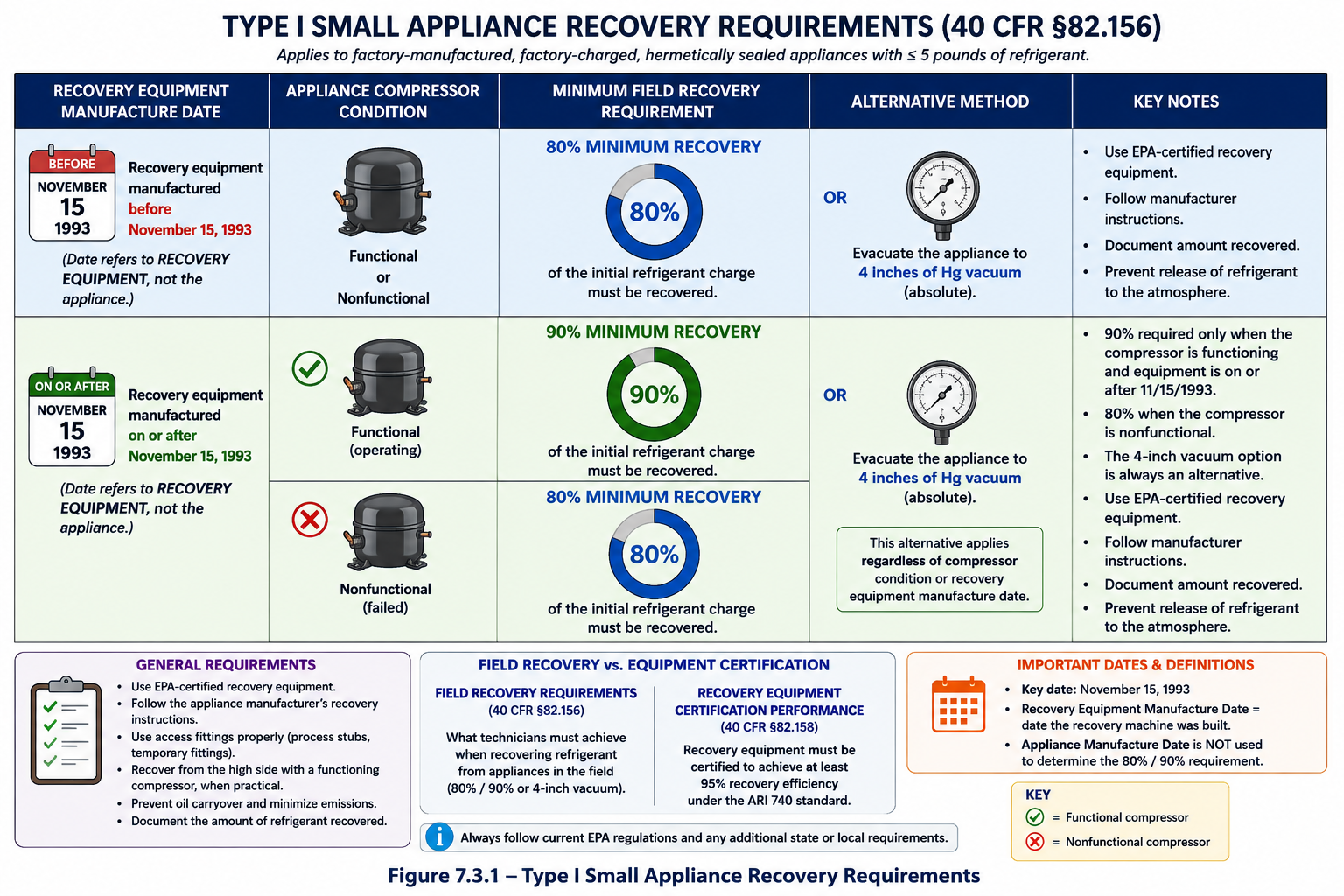
Figure 7.3.1 – Type I recovery requirement depends on recovery-equipment manufacture date and, for newer equipment, appliance-compressor condition.
AI-generated instructional figure: It may contain visual inaccuracies. Use the accompanying lesson text and cited authoritative sources to verify technical and regulatory details.
EPA 608 Exam Focus
Highest-Priority Table
| Exam Condition | Answer |
|---|---|
| Recovery equipment before Nov. 15, 1993 | 80% |
| Recovery equipment on/after Nov. 15, 1993, compressor works | 90% |
| Recovery equipment on/after Nov. 15, 1993, compressor does not work | 80% |
| Alternative | 4 in. Hg vacuum |
Exam Trap 1 — Wrong Date
The November 15, 1993 date refers to:
RECOVERY / RECYCLING EQUIPMENT
not:
APPLIANCE
Exam Trap 2 — Working Compressor Always Means 90%
Incorrect.
A working compressor gives the 90% percentage requirement only when using recovery equipment manufactured:
on or after Nov. 15, 1993
Pre-1993 equipment still uses:
80%
for the percentage path.
Exam Trap 3 — Failed Compressor Means Recovery Is Optional
Incorrect.
A failed compressor changes the required percentage with newer equipment, but recovery is still required.
Exam Trap 4 — Small Appliance Uses Main Table 1
Incorrect.
Small appliances have their own §82.156(b) rule.
Exam Trap 5 — Four Inches Means Four Inches Absolute
Incorrect.
The regulatory wording is:
4 in. Hg vacuum
Exam Trap 6 — Four Inches Is a Dehydration Vacuum
Incorrect.
It is a refrigerant-recovery endpoint.
Memory Pattern
OLD EQUIPMENT
→ 80
NEW EQUIPMENT + WORKING COMPRESSOR
→ 90
NEW EQUIPMENT + FAILED COMPRESSOR
→ 80
ALTERNATIVE
→ 4 in. Hg vacuum
Common Mistakes and Confusing Points
Mistake 1: Using Appliance Manufacture Date
The 1993 date refers to recovery equipment.
Mistake 2: Treating November 15, 1993 as Part of the “Before” Category
The regulation says:
on or after November 15, 1993
Therefore equipment manufactured on November 15, 1993 belongs to the newer category.
Mistake 3: Applying 90% Whenever the Appliance Compressor Works
The recovery-equipment date must also be considered.
Mistake 4: Applying 80% Whenever the Compressor Fails Without Reading the Rest of the Question
The 80% value is correct for the percentage path with a nonfunctional compressor, but the 4-in.-Hg alternative can also satisfy the rule.
Mistake 5: Applying High-Pressure Table 1 to a Refrigerator
Qualifying small appliances use their own Type I recovery rule.
Mistake 6: Confusing Equipment Certification With Technician Certification
A certified recovery machine is not the same thing as a certified technician.
Both concepts may matter, but they are different requirements.
Mistake 7: Confusing Equipment Certification Performance With Field Recovery Requirement
The same 90%/80% values appear in equipment testing and field compliance contexts.
Read what the question asks.
Mistake 8: Ignoring Manufacturer Instructions
The federal rule requires recovery equipment to be used according to manufacturer directions unless those directions conflict with federal requirements.
Mistake 9: Treating Any Recovery Machine as Safe for Flammable Refrigerant
Verify refrigerant compatibility and the applicable certification/safety rating.
Mistake 10: Treating 4 in. Hg Vacuum as a Micron-Level Dehydration Target
They are different procedures and pressure scales.
Concept-Check Questions
Question 7.3-1
A technician services a qualifying small appliance using recovery equipment manufactured in 1991. The appliance compressor operates normally. Using the percentage-recovery method, what is required?
A. 50%
B. 80%
C. 90%
D. 100%
Question 7.3-2
A technician uses recovery equipment manufactured in 2024 on a small appliance whose compressor is functioning. What percentage of refrigerant must be recovered under the percentage method?
A. 70%
B. 80%
C. 90%
D. 95%
Question 7.3-3
A technician uses recovery equipment manufactured in 2024 on a small appliance with a failed compressor. What percentage applies under the percentage method?
A. 60%
B. 80%
C. 90%
D. 100%
Question 7.3-4
What does the November 15, 1993 date refer to in the Type I small-appliance recovery rule?
A. Manufacture date of the small appliance
B. Manufacture date of the compressor
C. Manufacture date of the recovery or recycling equipment
D. Date the refrigerant was produced
Question 7.3-5
Which is an alternative method for satisfying the current small-appliance recovery requirement?
A. Evacuate to 25 mm Hg absolute
B. Evacuate to 4 in. Hg vacuum
C. Evacuate to 500 microns in every case
D. Reduce pressure only to 5 psig
Question 7.3-6
A refrigerator was manufactured in 1987. The recovery machine was manufactured in 2022, and the refrigerator compressor works. Which percentage applies?
A. 80%, because the refrigerator was manufactured before 1993
B. 90%, because the recovery equipment was manufactured on or after November 15, 1993 and the appliance compressor functions
C. 80%, because all refrigerators use 80%
D. No recovery is required for an appliance made before 1993
Question 7.3-7
Which statement correctly distinguishes recovery-equipment certification from the field recovery requirement?
A. They are exactly the same legal concept.
B. Equipment certification establishes equipment performance under specified testing conditions, while the field rule establishes the recovery result required before opening or disposal.
C. Equipment certification applies only to technicians.
D. Field recovery requirements apply only to manufacturers.
Question 7.3-8
Which statement about manufacturer instructions is correct?
A. They may always override EPA requirements.
B. They never need to be followed.
C. Recovery equipment must be used according to manufacturer directions unless those directions conflict with the federal requirements.
D. They matter only for pre-1993 equipment.
Answers and detailed explanations will be provided in
7.12 - Answers and Explanations.md.
Section Summary
The Type I recovery rule is straightforward once the controlling inputs are identified.
First:
Confirm small appliance
Then determine:
Recovery-equipment manufacture date
If the equipment was manufactured before November 15, 1993:
80% recovery
If the equipment was manufactured on or after November 15, 1993:
Compressor functioning
→ 90%
Compressor not functioning
→ 80%
The current rule also permits:
4 in. Hg vacuum
as an alternative small-appliance recovery endpoint.
The most important conclusions are:
- The November 15, 1993 date refers to recovery equipment, not the appliance.
- Small appliances have their own recovery rule and do not use the main Table 1 values.
- A functioning compressor matters for the post-1993 percentage path.
- A failed compressor does not remove the recovery requirement.
- The 4-in.-Hg vacuum value is a recovery endpoint, not a deep dehydration target.
- Percentage recovery and vacuum level are different forms of compliance measurement.
- Recovery/recycling equipment must satisfy the applicable certification requirements.
- Equipment must be appropriate for the refrigerant and intended appliance category.
- Recovery equipment must be used according to manufacturer directions unless those directions conflict with federal requirements.
The next section explains how technicians gain access to the sealed refrigerant circuit using process stubs and temporary service fittings while minimizing refrigerant emissions.
See Section 7.4 - Access Fittings and Process Stubs.
References
Current Regulatory and EPA Sources
-
Electronic Code of Federal Regulations, 40 CFR § 82.156 — Proper Evacuation of Refrigerant from Appliances, especially §82.156(b) for small-appliance recovery and §82.156(g) for manufacturer directions. Accessed August 11, 2026.
-
Electronic Code of Federal Regulations, 40 CFR § 82.158 — Standards for Recovery and/or Recycling Equipment, especially §82.158(e) for small-appliance recovery-equipment certification and §82.158(h) for equipment labeling. Accessed August 11, 2026.
-
U.S. Environmental Protection Agency, Stationary Refrigeration Service Practice Requirements, current EPA summary of 80%, 90%, and 4-in.-Hg-vacuum small-appliance requirements and manufacturer-direction requirements. Accessed August 11, 2026.
-
U.S. Environmental Protection Agency, Refrigerant Recovery and Recycling Equipment Certification, current EPA summary of small-appliance recovery-equipment performance standards and EPA-approved testing organizations. Accessed August 11, 2026.
-
U.S. Environmental Protection Agency, Test Topics — Section 608 Technician Certification, current Type I test-topic framework identifying recovery requirements for small appliances with working and nonworking compressors and recovery equipment manufactured before versus after November 15, 1993. Accessed August 11, 2026.